4.95s · 93 min after sunset · Warleigh Nature Reserve, River Avon, near Bath
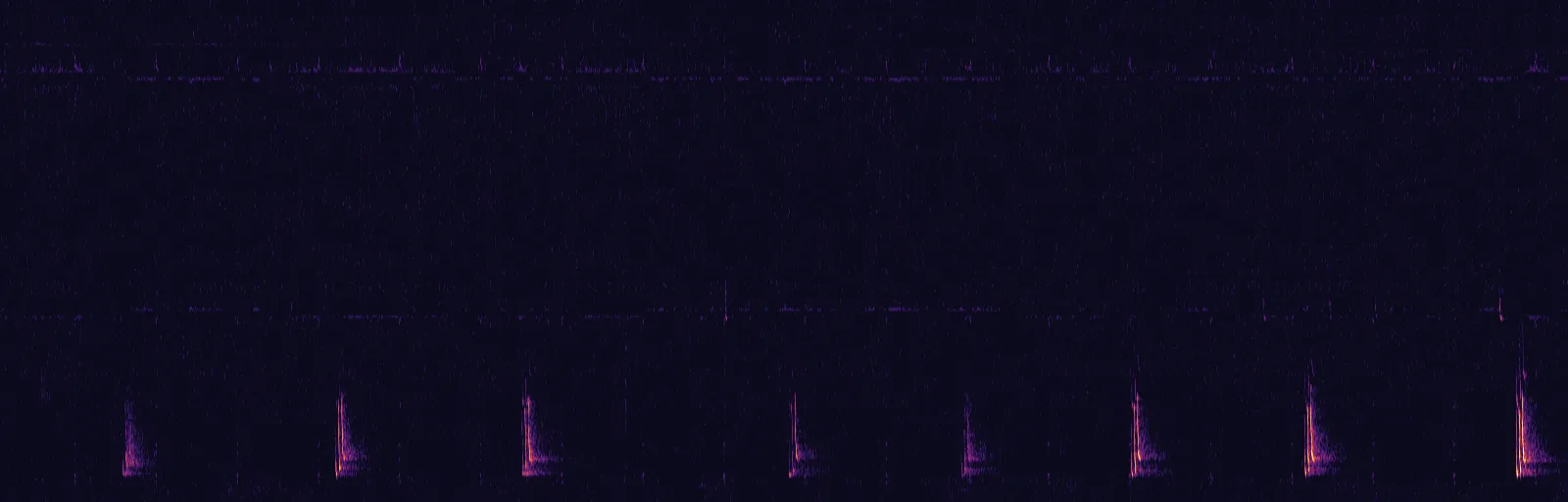
0.0 / 4.9s
Sound is slowed down 10 times to bring it into hearing range, so a call at 46 kHz is heard at 4.6 kHz.
What was detected
- Long-eared bat · closest match Plecotus austriacus of 2 · 3 calls · 16.5 kHz · strongest 0.344Measured 16.5 kHz is far outside the expected range for this label. Flagged for review rather than corrected: this measurement is not precise enough to name an alternative. This is a protected species, so the claim is held back.
- Noctule, Leisler's or serotine · closest match Nyctalus noctula of 3 · 2 calls · 20.6 kHz · strongest 0.331
- Soprano pipistrelle (Pipistrellus pygmaeus) · 2 calls · 53.2 kHz · strongest 0.62
BSG-BAT and Kaleidoscope disagree. BSG-BAT identified Lesser horseshoe bat instead. Kaleidoscope identified Brown long-eared bat instead.
All 10 detections
| Time | Label | Band | Detection |
|---|---|---|---|
0.39s | Nyctalus noctula | 16 to 24 kHz | 0.509 |
1.06s | Plecotus austriacus | 16 to 31 kHz | 0.511 |
1.65s | Plecotus austriacus | 16 to 34 kHz | 0.552 |
2.03s | Rhinolophus hipposideros | 93 to 111 kHz | 0.573 |
2.29s | Pipistrellus pygmaeus | 53 to 59 kHz | 0.567 |
2.51s | Nyctalus noctula | 19 to 31 kHz | 0.528 |
2.80s | Rhinolophus hipposideros | 93 to 110 kHz | 0.503 |
3.99s | Pipistrellus pygmaeus | 53 to 58 kHz | 0.558 |
4.73s | Pipistrellus pygmaeus | 53 to 64 kHz | 0.656 |
4.78s | Plecotus austriacus | 16 to 42 kHz | 0.558 |